“Without our quite realizing it, wilderness tends to privilege some parts of nature at the expense of others.” If Cronon for some odd reason was to be on the Geneseo campus and pass by The Greek Tree I think that he could have wrote another piece just on this experience. Cronon would first appreciate the tree because it resembles the college’s observance of nature and the use of nature to socially connect with everyone on campus. Cronon would also criticize the tree because one of his main arguments is that humans should worship all of the ordinary nature around us and not just the unique, picturesque views that nature is perceived to be. Cronon makes it clear in his work, “Trouble with the Wilderness” that humans make the mistake of only looking for mighty canyons than humble marshes because we look for the divinity in wilderness and feel that the everyday wilderness has no divinity to it. Cronon would tell me that I should have admired all of the trees that I passed by on my way to admire The Greek Tree.
“We have never been modern, but we have found a way of thinking that we were” is stated by Bruno Latour in We Have Never Been Modern. Latour centers his piece around the idea of “modernism” and talks about how “modernism” deals with “purification” and “translation.” Latour compares science and sociology together and talks about how the world tries to keep these domains separate to be more modern as a society. He states that this is a paradox at its finest because the act of keeping society separate from nature is not allowing our society to reach a modern era. When I read Latour’s writing I found The Greek Tree to perfectly exemplify the vocal point of Latour’s writing. The Greek Tree allows students to support their fraternal/sorietal organization, which they have a tremendous amount of pride in and they get to express their way of life(culture) through the natural world.
Wilderness has been around for the best and worst times of history and has always played a key role in the life of our planet. Wilderness was there when Jesus was tempted by the devil in the desert, but wilderness was also there to give men such as Henry David Thoreau an experience with the divine world. An idea of Cronon’s that aroused questions within me was when he stated that “If nature dies because we enter it, then the only way to save nature is to kill ourselves.” I found this quote to be very radical and inaccurate because humans are nature and we as a species are biologically designed to live in union with nature. I definitely do see the author’s ideas intertwining very nicely into my mini-essay due to the fact that the author is a lover of nature and the SUNY Geneseo campus is a sensational place that truly shows the world the true beauty of wilderness.
“Late twentieth-century machines have made thoroughly ambiguous the difference between natural and artificial, mind and body, self- developing and externally designed, and many other distinctions that used to apply to organisms and machines” is a statement stated by Donna Haraway that is extremely controversial and opinionated.
The main idea in this writing is the belief that people (specifically women) must be liberated from a patriarchal society and from a culture being taken over by technology. Donna Haraway’s piece is extremely ironic because she emphasizes the point that no human being should express individuality and that we must all be labeled under the same group. In reality, we should embrace our differences and cherish our uniqueness because if human beings are not different from each other, then we are indeed all cyborgs.
I found the author’s ideas to be very opinionated and I do not see her ideas connecting in anyway way to my object in my mini-essay.
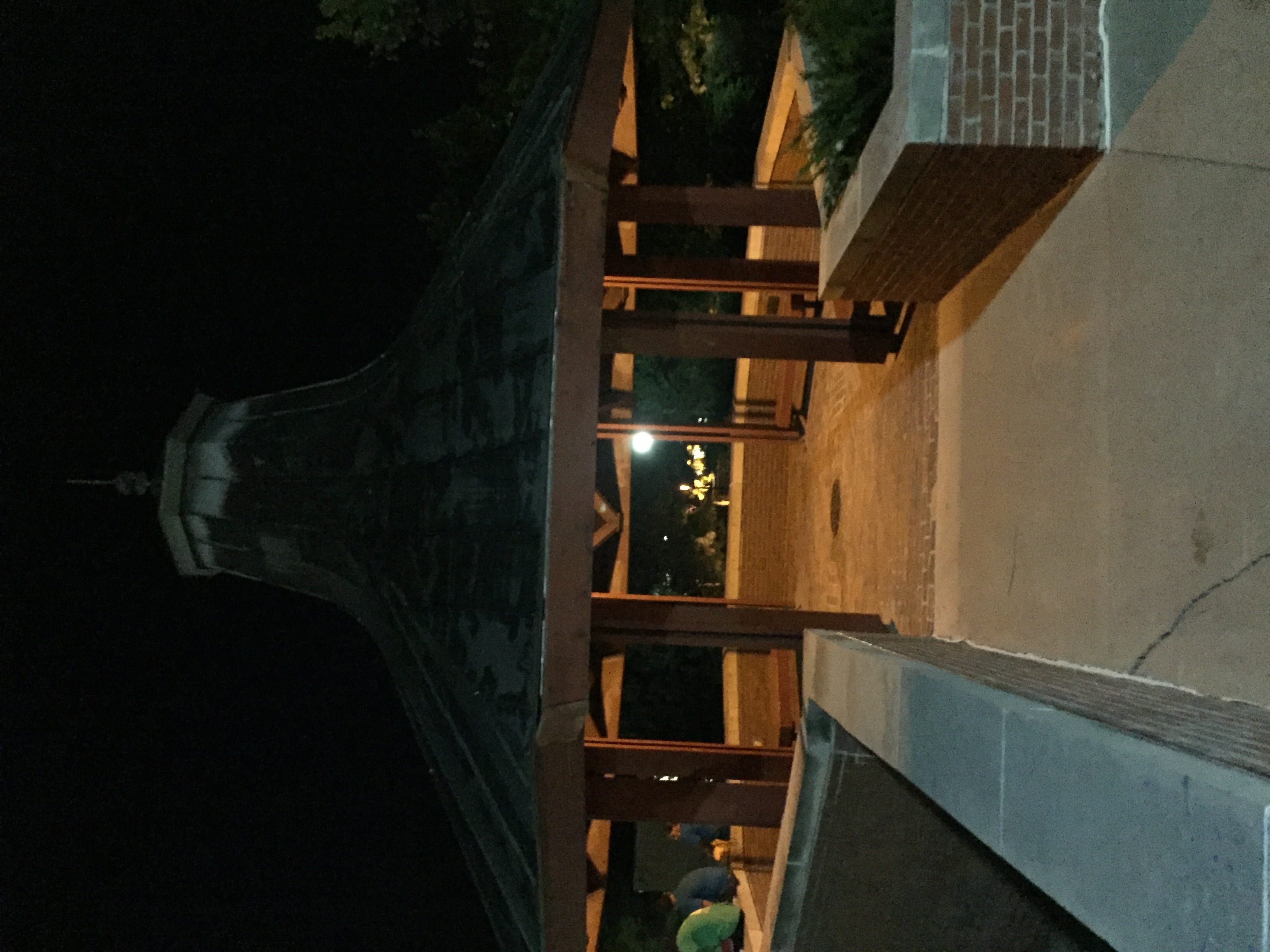
Nature is a powerful force that so often is taken for granted. Unfortunately, the beauty of nature is disregarded by many. Nature is continuously polluted by modern technology and progressive industrialization. The more humans build, the more disregarded nature becomes. A select few amount of careful observers will see many monuments on the picturesque Geneseo campus like the gazebo.
The Geneseo gazebo is beautiful in an innumerable amount of ways. It is a perfect representation of how nature and artificially crafted objects can co-exist together. The gazebo serves as a fantastic space in which students and faculty alike can feel more at home on the Geneseo campus. Even though it is a man-made structure, the gazebo actually gives the campus a more natural feel. The gazebo has many purposes which include magnifying sunsets and making each beautiful sunset look as if one has never seen a sunset before. Also, it shows the true beauty of the cosmos that we are able to observe. The topography of the Geneseo campus is completed by the Gazebo as it perfectly intertwines with the hills of Geneseo. I am a Long Island native and it is unusual for me to see such open land. It’s magnificent to see nature in such a calm state and to have the gazebo not look artificial, but indeed hand crafted by nature.
We must all learn to embrace nature and appreciate the true beauty of it as it is in all of our roots.