All posts by Patrick Jones

We Have Never Been Modern

Patrick Jones                                                                Approximately 150 words

pwj2@geneseo.edu

INTD 105-19: Science Writing

We Have Never Been Modern

            We as a collective find it necessary to separate and classify everything around us. In Bruno Latour’s writing, We Have Never Been Modern, he addresses this necessity of ours and explains how it hinders our ability to be a “modern” world. Using a newspaper, Latour explains how problems like the diminishing ozone layer cannot be separated into distinct categories because, “A single thread links the most esoteric sciences and the most sordid politics…” For us to become a modern world we will either have to stop our need to categorize all aspects of society and nature or redefine what it means to be modern.

My view on the parking curb behind Milne Library acting as a division between nature and civilization contradicts Latour main argument in We Have Never Been Modern. My clear division ignores the multitudinous connections Latour argues exists between everything and stops humanity for entering a modern age.
The Trouble with Wilderness

Patrick Jones                                                               Approximately 150 Words
pwj2@geneseo.edu
INTD 105-19: Science Writing

The Fallacy of Wilderness

In William Cronon’s essay, “The Trouble with Wilderness”, he addresses the major problem modern environmentalists face in defining the wilderness as natural. Cronon argues that over the past 250 years, the connotation of wilderness has changed from being uncertain and fearful to “a symbol of God’s presence on earth.” , making wilderness a manipulation of civilization. The monopolization of this definition and it’s use as a way to escape reality has created a problem for environmentalists by setting a high standard for what counts as natural that “…the landscape that for better or worse we call home.” does not meet. This fallacy we created for wilderness has caused modern environmentalists to protect the aspects of nature that provide a spectacle at the expense of the trees in our own backyards.
When looking at the parking curb behind Milne Library, I saw a clear dualism between wilderness and civilization. In his essay, Cronon believes that this view of separation between the worlds only divides us more, leaving ourselves “…little hope of discovering what and ethical, sustainable, honorable human place in nature might actually look like.”

“The Cyborg Manifesto”, Donna Haraway

Patrick Jones                                                              Approximately 150 Words

pwj2@geneseo.edu

INTD 105-19: Science Writing

“The Cyborg Manifesto” Summary
By Patrick Jones

In Donna Haraway’s “The Cyborg Manifesto”, she uses a cyborg as a symbol of the broken boundaries between the natural and artificial worlds and then discusses the use of gender and race as an identifier.
In her piece, Haraway uses the cyborg to discuss three different broken boundaries. Firstly she describes the boundary between animals and humans, that has been broken as animals rights activism has increased over the last few decades. The second and third boundaries are between organisms and technology and the physical and non-physical worlds, which have both been broken by the increase in technological use in everyday life. Haraway then precedes to discuss how humans use gender and race to divide society instead of working to create unity.
It appears Haraway and I have different views on the division between worlds. When I saw the concrete curb behind Milne library I saw a clear division between the artificial and natural worlds while Haraway sees a more faded division that is continuing to disappear.

The Division Between the Natural and Artificial Worlds.

Patrick Jones                                                           Approximately 250 Words

pwj2@geneseo.edu

INTD 105-19: Scientific Writing

The Curb

By Patrick Jones

The beautiful campus of SUNY Geneseo appears to be a surreal blend of both the natural and artificial worlds, creating a paradise on earth for all of those who study upon it. Amongst the tall trees and unforgiving hills is an evident division between the subjective and objective domains that goes unnoticed by the students. A great example of this division is the lonesome curb block on the hill behind Milne Library.

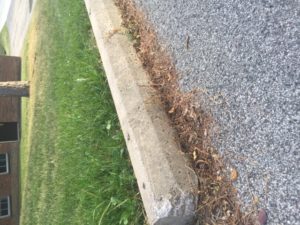
From a distance this concrete block sits, cracked, with very little purpose. Everyday students march past, unaware of the strange object planted to the ground at their feet. Close to five inches away from the path, the block doesn’t act as good physical division. One could simply walk around the curb, mixing the artificial and natural worlds, but the separation lies in the ground surrounding it. On the side furthest from the path the grass is flourishing, symbolizing the relentless success of nature, while the side closest to the path is dead. The grass races towards the block with open arms, trying to scale the small concrete tower, but the second it hits the other side of the block, it dies.

The natural world, the farther side of the block, is full of life while the artificial world, the closer side, withers. The artificial world in which we immerse ourselves is fake, unfruitful, and unprosperous in comparison to the everlasting natural world.How are we supposed to proper as human beings in a world that can’t sustain life?

The Curb Block behind Milne Library

IMG_2642