All posts by Matthew Klein

We Have Never Been Modern Response

Matt Klein                                                            approximately 180 words

mgk6@geneseo.edu

INTD 105-19: Science Writing


We Have Never Been Modern Response

By Matt Klein


In his book We Have Never Been Modern, Bruno Latour analyzes the divisions that modernity has constructed between man and nature. While ancient societies made no distinctions between these, “modern” culture has separated the fields of science and sociology discrete groups. Latour defines his idea of modernism at the end of the first chapter. In order for modern society to “remain effective,” we must “[designate] two sets of entirely different practices which must remain distinct.” These practices are “translation,” which creates hybrids of nature and culture, and “purification,” which separates humans and nonhumans. While this seems paradoxical, Latour argues that both must exist in order us to become truly modern.

The Arboretum seems like a valid example of the practice of translation since it combines both nature and culture. I’m curious about how it has been viewed in the local media though, specifically whether or not it has been viewed as a separate part of campus unrelated to any other or if it has been discussed along with other aspects of the Geneseo culture. This would be a good point to research for my final essay.
“The Trouble with Wilderness” Response

Matt Klein                                                            approximately 250 words

mgk6@geneseo.edu

INTD 105-19: Science Writing


“The Trouble with Wilderness” Response

By Matt Klein


William Cronon begins his argument describing humanity’s relationship with nature by explaining past and current beliefs about wilderness. Before the nineteenth century, the “wilderness” was something to be feared. Few ventured there, and the biblical association with the word—the place of Moses’ exile and Jesus’ struggle with Satan—was extremely negative. With the coming of writers such as Thoreau and John Muir, that connotation was completely reversed. Cronon gives two sources for these individuals’ reactions to the wilderness: the sublime, the grandeur of nature through with God can be seen, and the frontier, the opportunity for people to free themselves from civilization through primitivism and become their own individuals. This sentiment led to the birth of environmentalism and conservation in order to preserve the sublime and the frontier. The focus of “The Trouble with Wilderness” is Cronon’s disagreement with the concept of conservation for nature’s sake. Though he admits we should honor nature since it has its own autonomy, he argues that, in attempting to preserve nature, we ironically bring human culture to it. Cronon believes that, if we accept our involvement in nature, “if wildness can stop being just out there and start being also in here,” then we can “[struggle] to live rightly in the world.”

“The Trouble with Wilderness” strongly relates to my mini-essay about the Arboretum. Since the concept of the Arboretum is similar to the parks and nature preserves mentioned by Cronon, his analysis can be directly applied to the relationship of nature and human culture seen at the Arboretum.

“The Cyborg Manifesto” Response

Matt Klein                                                            approximately 150 words

mgk6@geneseo.edu

INTD 105-19: Science Writing


“The Cyborg Manifesto” Response

By Matt Klein


In the late twentieth century, many boundaries in society were beginning to break down. In “The Cyborg Manifesto,” Donna Haraway analyzes these boundaries in the context of technology and socialist-feminism. In her main points, she discusses the division between humans and animals, organisms and machines, and the organic and inorganic. Haraway demonstrates how these divisions have begun to disappear, and she hybridizes these pairs into the image of the cyborg. The cyborg represents the transgression of each of these boundaries, leading to a more unified society. In her words, “The cyborg is a creature of a post-gender world; it has no truck with bisexuality, pre-oedipal symbiosis, unalienated labour, or other seductions to organic wholeness through a final appropriation of all the powers of the parts into a higher unity” (292). Haraway thus illustrates how our world is transitioning from individualism to the inclusion and wholeness of our entire society.

This relates to my mini-essay on the arboretum in the sense that the arboretum, like the cyborg, is a hybrid of humans and nature.

The Geneseo Arboretum–A Blend of Two Worlds

Matt Klein                                                                       approximately 250 words

Mgk6@geneseo.edu

(585)-905-6701

INTD 105-19


The Geneseo Arboretum—A Blend of Two Worlds

By Matt Klein


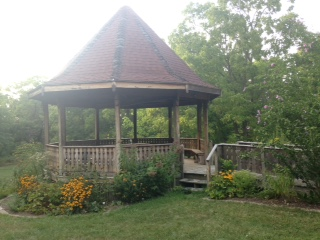
As many high school students journey to Geneseo in their search for a college, Geneseo students and staff are quick to point out the natural beauty of the campus. It can be seen everywhere, from the Greek Tree and Seuss Spruce to the ivy-covered buildings. Perhaps the best example of this combination of nature and civilization is the Arboretum located to the south of campus. Though at a distance it simply seems to be a small forest, up close the care and attention given by Geneseo community pops into view. At the center of the Arboretum lies a gazebo, the most obvious integration between human presence and the surrounding environment. The gazebo is a simple wooden structure surrounded by flowers, yet the obvious care that has gone into its maintenance demonstrates the great love the community has for the trees.

Most surprising to me was the attention paid to the environment around the gazebo. The trees and bushes have been meticulously marked and identified by small tags. These tags, though practically insignificant compared to the surrounding beauty, make the Arboretum much more than just a collection of paths carved through a grove of trees. Each tree has been scrutinized and cared for, all the while retaining its natural splendor for the pleasure of observers. This makes the Arboretum an excellent example of the beauty that can result from the coexistence of nature and human influence.

image1_120086_