All posts by Justin D'Souza

Thoughts about Cronon’s Argument

Justin D’Souza                                                                              About 210 Words   SUNY Geneseo                                                                                                             INTD 105 Science Writing


Response to William Cronon’s Argument

By Justin D’Souza


When humanity considers the “wilderness,” we tend to consider the beautiful forests as natural, while the trees that litter backyards and cities as unnatural. William Cronon attacks this idea, calling for us to “abandon the dualism that sees the tree in the garden as artificial…and the tree in the wilderness as natural.” He correctly asserts that if we stop seeing some nature as special, we can move to protect all wild things, not just certain areas that we see as godly. Here, Geneseo’s Arboretum corroborates Cronon’s theory. I would contend there exists nothing extraordinary about it, and therefore gives proof that positives can result from protecting even mundane areas.

Yet, the very same evidence that supports Cronon’s attack on our dualistic view of nature, I would argue subverts his strong feelings towards modern conservation ideology. Cronon passionately believes human only disturb nature when we try to save it. He also claims environmentalists only want to protect extravagant far off places. But the arboretum challenges that…it has not destroyed anything…nor does one view it as godly. While Cronon does wish for close to home efforts, he denies they exist…he fails to consider the good of small scale projects like this and instead chooses to critique a very generalized version of environmental protection.
Justin D’Souza                                                                               About 170 words

SUNY Geneseo

INTD 105 Science Writing


False Dichotomies of “Modern” Society

By Justin D’Souza

When one browses a newspaper, one encounters many neat sections: “science, politics, economy, law, religion, [etc.].” But the complexity of modern issues goes beyond labels. For example, a story about the ozone layer blends science and politics. Latour argues that we too frequently create false dichotomies between human events and natural/scientific events due to our inability to properly classify such hybrid “networks.” However, every culture has these interconnected networks – an anthropologist analyzing an ancient culture will synthesize them, like a “narrative” Therefore, old cultures did not have the false dualisms modern culture has that separates us from nature and science. We uphold this dualism so we can think of ourselves as more modern than others, the West versus the old. But since this dualism does not really exist, we are like ancient cultures, aka not modern.

#

Geneseo’s Arboretum certainly seems like an example of a “nature-culture,” But, I predict that if a discovery were found in the trees, it would be confided to the science section of a newspaper regardless of if it relates to other fields.

The Paradox of Wilderness

Justin D’Souza                                                                                                                            About 170 words    SUNY Geneseo

Science Writing


The Paradox of Wilderness

By Justin D’Souza

Many equate “wilderness” with gorgeous, expansive swaths of land, free from any human influence whatsoever.  However, William Cronon challenges the notion that wilderness opposes the human world, calling it a “profoundly human place.” Unlike biblical times, where the wilderness represented the devilish deserts and jungles outside of Eden, environmentalists like John Muir perceived wilderness as a “sublime [godly]” region. This coupled with the idea of a “manly” frontier led many rich capitalists to nature…but only for the mere pleasure of recreation – the wilderness has been designated by humans for humans. In today’s age, environmentalists urge saving biodiversity against human interference, however, the only way to do this, besides killing off our entire species, is interference in nature. Therefore, irony and paradoxes cripple modern environmental ideology.

#

Geneseo’s Arboretum correlates with Cronon’s thoughts. Far from sublime and godlike, it is a “wild place close to home.” This allows us to “abandon the dualism that sees the tree in the garden as artificial…and the tree in the wilderness as natural.” The arboretum blends both a garden and forest.

Haraway’s Cyborg

Justin D’Souza                                                                               About 160 words   SUNY Geneseo                                                                                                           INTD 105 Science Writing


Haraway’s “Cyborg”

By Justin D’Souza


The word “cyborg” evokes images of strange human hybrids, products of an apocalyptic future. Yet, feminist Donna Haraway envisions the cyborg as a being that unites humans and animals, challenges the conventional definition of identity, and exemplifies how modern technology has blurred traditional boundaries between humanity and our universe. She hopes her “Cyborg myth” conveys “transgressed boundaries,” leading us to reject traditional separation of “mind and body, animal and machine.” She argues these false dualisms frequently emerge in socialist and feminist thinkers; therefore, she finds flaws with current ideology. To her, feminism must not be rooted in Marxist labor class struggles, but novel technological breakthroughs that will redefine gender, race, and class.

I wonder if today’s changes in both cybernetics and social thought regarding feminism and liberal policies have caused Haraway to revise her theory. Her ideas can be applied to our objects, as she conveys the benefits of blurring boundaries between humans and nature, just as the Arboretum sign encourages coexistence between humans and trees.

Justin D’Souza Blog #1

Justin D’Souza                                                                                            255 Words   Science Writing                                                                                                  Geneseo


Distinguishing the Boundary Between the Natural and the Artificial                                                          By Justin D’Souza

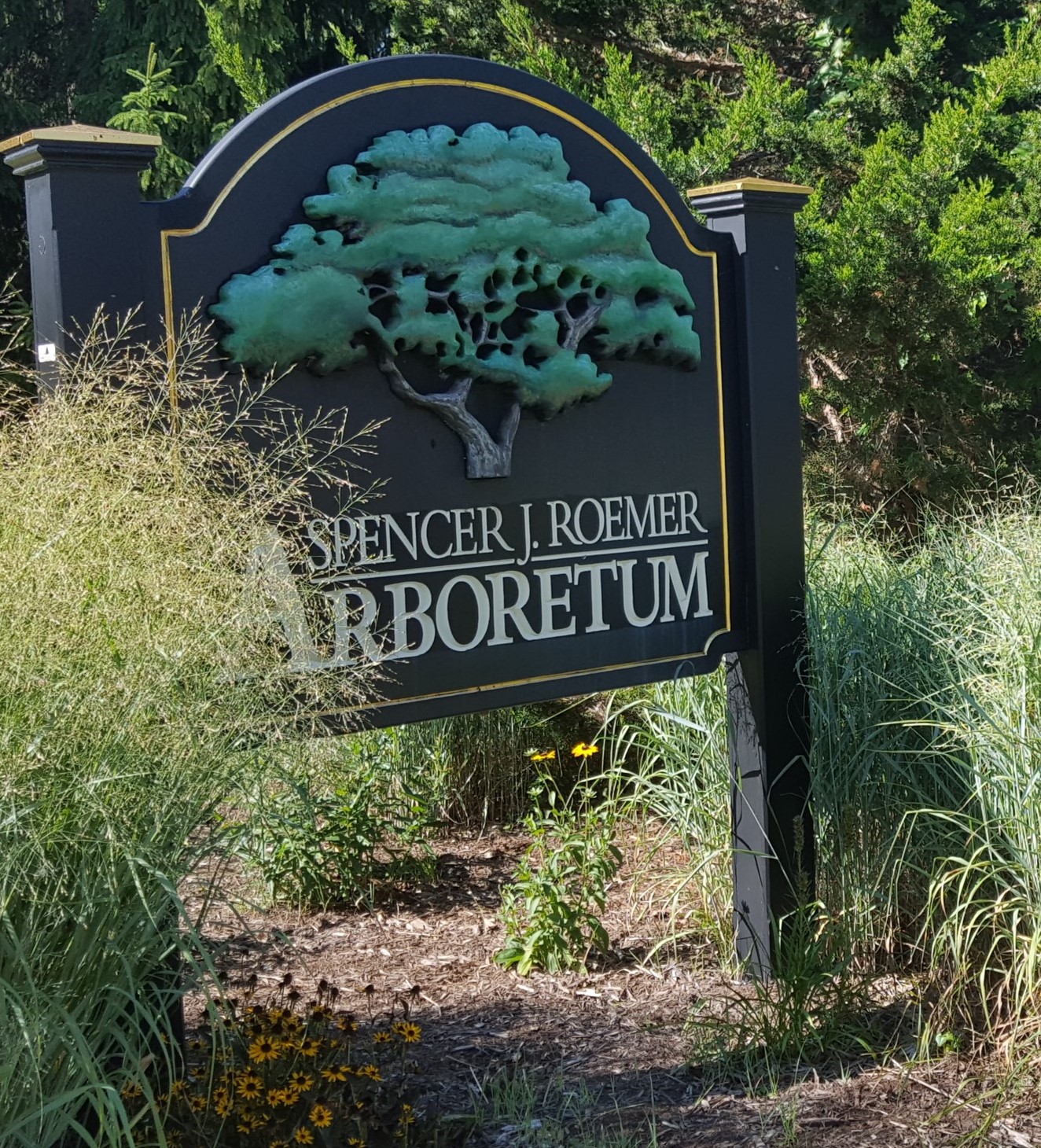
Often, signs offer crucial information to passersby: the location of something, facts, or simply the name of a particular place. Signs on campus are no different. The “Spencer J. Roemer Arboretum” sign, located in a quiet grove of bushes, provides information that gives readers a good indication of boundaries between the natural world and human habitation.

Walking across the pavement of lot J after I got out of the hot rectangular Onondaga Hall, I noticed the sign peek into view behind some neighboring green bushes, with a visible tree detailed onto it, and some words I couldn’t yet read. Close up, the letters designate that this area forms an arboretum, a small grove of trees perhaps being studied by scientists. Therefore, an interesting juxtaposition emerges – to the left, trees and tranquility, yet to the right, hard asphalt and loud rap music. In class, we study from man made textbooks and computers and chalkboards. Yet, the sign and arboretum, despite both obviously created or designated by humans, invites one into a world where both humans and nature can coexist…but only for so far, after all, roads eventually constrict the trees into this one nook on campus!

I wonder if this sign could be a metaphor for science. It is not a random black and white street sign or some flashing neon creation, but a green and brown “gate” that invites people to explore the wild. I believe that this is what science should be, a field driven a curiosity to discover more about the world we live in!

20160830_103212