All posts by Inactive Account

Tremper, Anticipating Haraway’s Reaction to a Stump

Juniper Tremper
Scientific Writing 105-19
Geneseo, NY
~180 words

Efforts to Make Amends Are No Substitute for the Original
Juniper Tremper

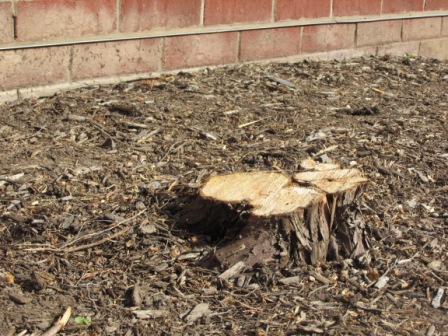
Donna Haraway would not appreciate the tree stumps outside the townhouses. Her paper describes the complexity of a world that does not struggle with the boundaries created by humans and  refers to the labels we designate for genders, but the tree stumps are their own imposed boundaries. Like the distinction between genders, the tree stumps only exist because we put them there, and they serve no practical purpose. The argument Haraway writes about applies to the conceptual construction of something (gender boundaries), but even her points about the inability to return to a unity as perfect as the original can be applied directly to the physical construction of the trees in the townhouse dirt plots. As she would have noticed, the development of the paved strip between the buildings created a boundary between nature and ourselves, and our attempt to reintroduce nature in the form of a selective planting of trees has ultimately made no improvement, because “no construction is whole” and while the boundary exists between us and the beauty of nature, there’s no way to just overlook our distance apart.
Tremper on We Have Never Been Modern

Juniper Tremper
Scientific Writing 105-19
Geneseo, NY
~165 words

Modern Contamination
Juniper Tremper

If you, like Latour, believe that perfect distinction between categories defines being modern, then this chapter rings truth. We as humans voluntarily “retie the Gordian knot” of labels because we value titles that have been customized for our specific circumstances. After all, as Latour notes, we are hybrids ourselves. However, he says these complex distinguishments do not prove us to be modern, explaining that we have two goals as a civilization: the work of purification, and the work of translation. Purification refers to keeping humans separate from nature, while translation includes creating custom labels and hybrids. As Latour claims, “as soon as we direct our attention simultaneously to [both], we immediately stop being wholly modern.” The self described paradox that he proceeds to detail raises the unanswered question of what will we become if we do not have clear separation.

His writings are curious to consider, but have no clear comparison to the tree planted only to be cut down, unless you rearrange the tree’s situation to be hybridized to better suit your point.


Tremper on The Trouble With Wilderness

Juniper Tremper
Scientific Writing 105-19
Geneseo, NY
~170 words

The Contradiction of Saving Natural Beauty
Juniper Tremper

Throughout his analysis of wilderness, William Cronon never denies the majesty of waterfalls and vast canyons. His point is not that the world is less beautiful than before, but rather, the idea of “wilderness” is littered with ironies and contradictions. Primarily, wilderness once offered connection with God, because in the untouched savage lands, “the boundaries between human and nonhuman” were less. Where we experience crippling awareness of our insignificance, we are most likely to connect to higher power. The contradiction comes with the tourists. Although the scenery is still grand, the tourist’s experience is “familiar enough to be instantly recognizeable,” unlike Cronon’s many literary references, whose revelations were distinctly unique. Furthermore, he points out, the only way to prevent all human destruction of nature is to rid the world of humans.

His observation is relateable to a tree planted only to be cut down, because we conclude that present conditions are not the right ones for proper appreciation. A tree planted amid cement is not a tree so much as a sculpture.

Tremper, on A Cyborg Manifesto

Juniper Tremper
Scientific Writing 105-19
Geneseo, NY
~170 words

A Cyborg, A Stump, and A Counterproductive Feminist Idea
Juniper Tremper

The beginning of A Cyborg Manifesto describes the deteriorating boundaries of “what counts as nature.” Donna Haraway’s lengthy metaphor of a cyborg as a genderless being   analyzes the usefulness of such an existence, and states outright that they could be an “imaginative resource suggesting some very fruitful couplings.” In other words, there are advantages to embracing cyborgs because their neutrality unbinds them from our traditional loyalties to politics and parents. Haraway references the importance another professor places on “the limits of identification,” and elaborates that the gender labels we abide by are limiting boundaries, by inadvertently creating inescapable sexual objectification. She proceeds to explain that “transgressed boundaries” are also beneficial when applied to the dissonance between genders: that labels marginalize what effects would be possible in a “cyborg society” where dissimilar people “hold together… long enough” to achieve a common goal. In such situations, ignoring labels improves their ability to unify and cooperate.

Like a tree planted to be cut down, the purpose and use of identifying “women’s history” contradicts itself.


Tremper, on the boundary between humans/nature.

Juniper Tremper
Scientific Writing 105-19
Geneseo, NY
~270 words


The Absence of the Foliage
by Juniper Tremper

The curious bit about our interference as humans in the natural word is our constant efforts to remain connected to the way it was, prior to our meddling. The townhouses, built years ago, offer a beautiful view of the western horizon, but the entire stretch between the houses has been paved over, with the exception of a series of triangular plots filled with mulch. Each plot is identical: brown, woodbased mulch, roughly three footsteps from any corner to another, and most importantly, enclosing a stump. Not a tree, but a stump. We redesignated these sections of land as homes for college students, constructing the infrastructure to suit our purposes, and we cemented over any visible grass so no weeds could go through. But we planted trees evenly between the houses because we still wanted to feel like we were outdoors while walking across our human-made terrain from one human-made building to another. Then, for some unlisted reason, we cut the trees down. We severed the connection to nature that we so decisively planted, and somehow, even though the horizon glows unmatchably natural shades of orange, the stumps are a sad sort of reminder that as easily as we can let ourselves become a part of nature, so too can we distance ourselves.

No one seems to know whether there are plans to bring back the trees. To be fair, why make the effort, if no one notices the absence?

Perhaps the trees were growing up too close to the west-facing windows, and the foliage was blocking a resident’s view of the beautiful nature just outside their closed window…

IMG_2549compress