All posts by Erik Buckingham

Erik Buckingham                                                         approximately 200 words

ekb7@geneseo.edu

INTD 105-19: Science Writing


William Cronan and Seuss Spruce Graff & Berkenstein Arguments

By: Erik Buckingham

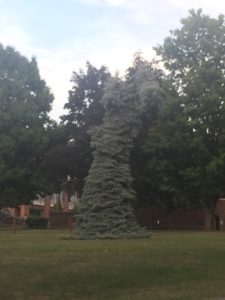
            Most people will tell you that a waterfall in the woods is wilderness, but the grass and trees behind their house is lesser. I wholeheartedly endorse William Cronan’s claim that if wilderness, “can start being just as humane as it is natural, then perhaps we can get on with the unending task of struggling to live rightly in the world” (Cronan, 109). The Seuss Spruce’s imperfection is the core of its beauty. Its curved trunk symbolizes the positive neglect of a grounds crew after a harsh storm.

Adding to Cronan’s argument, I would point out that we can neglect nature while coexisting with it. After the storm, Geneseo laid gravel pathways and set up metal benches in the Seuss Spruce’s surrounding area. Cronan’s theory that a person with empathy and an innovative mind can experience wilderness anywhere (Cronan, 108) sheds light on the difficult problem of whether or not the college should trim the Seuss Spruce. If we have successfully built a quad around the tree, why can’t we learn and live with the Seuss Spruce growing freely? When we stop struggling to live rightly, we learn to coexist with the unconventional.
 

Erik Buckingham                                                        approximately 150 words

10 MacVittie Circle

Geneseo, New York 14454

ekb7@geneseo.edu


“We Have Never Been Modern” Response

By: Erik Buckingham

In the New York Times, a few pages about biological and chemical advancement are listed under “science times” while political articles are seen throughout the whole newspaper. Author Bruno Latour’s views on modernisms stem from this separation of politics and nature.

In “We Have Never Been Modern”, Latour states that, “the analysts, thinkers, journalists, and decision makers will slice the delicate network… into tiny compartments where you will find only science, only economy, only social phenomena, only local news…”Latour believes that the more separate we keep our research in social and natural science, the more we will discover reasons to combine the two. He states, “the more we forbid ourselves to conceive of hybrids, the more possible their interbreeding becomes.”

The Suess Spruce is a tree that stands for perseverance, intertwining it with biology and society. This is a paradox because we are at a college that separates biology and sociology into two separate departments.

Erik Buckingham                                                         approximately 150 words


ekb7@geneseo.edu


Student, INTD 105-19: Science Writing


“The Trouble With Wilderness” Summary

By: Erik Buckingham


Environmentalists take action against the destruction of wildlife, attempting to preserve national parks for as long as possible. It has been discovered that our ancestors viewed nature as something to be avoided rather than something to be appreciated. In “The Trouble With Wilderness”, William Cronon explains that, “Wilderness, in short, was a place to which one came only against one’s will, and always in fear and trembling.”

Cronon envisions a world where we do not have to go outside a city to appreciate wilderness and nature. For example, trees and flowers lining the streets of Boston are not affected by the concrete around them, and people living in the city are not negatively affected by the trees. My mini-essay relates to this because the Suess Spruce tree is found in the middle of a college campus. We learn and live in brick buildings but allow various trees, especially the Suess Spruce, to exist.

“A Cyborg Manifesto” Summary

Erik Buckingham                                                         approximately 150 words

ekb7@geneseo.edu

Student, INTD 105-19: Science Writing


“A Cyborg Manifesto” Summary

By: Erik Buckingham

Many people feel that the boundary between humans and nature is becoming blurrier. Feminist writer Donna Haraway states in “A Cyborg Manifesto” that “Biology and Evolutionary theory over the last two centuries has… reduced the line between humans and animals to a faint trace.” We as a Geneseo community have personified the Suess Spruce by recognizing it as a symbol of perseverance. Through this interaction, we are eliminating boundaries between humans and nature.

Despite her view on animals and nature, Haraway feels that humans continue to recognize our differences in regards to gender, race and sexuality. She feels that our coexistence with other organisms is getting better, however, we are placing social barriers between our own species. By eliminating barriers between social differences, Haraway feels that a “cyborg” is formed. Eliminating our differences altogether leaves no room for cultural celebration.

Blog Post “They Say” Erik Buckingham

Erik Buckingham                                                                             about 250 words

400 Ridge Road

Oriskany, NY 13424

(315) 939-9091

ekb7@geneseo.edu


Student, INTD 105-19


The Seuss Spruce

    by Erik Buckingham

Many Geneseo students see the Suess Spruce tree as a landmark on campus. Located in the heart of campus on the quad, the Suess Spruce tree bends to the side like the hat from Dr. Suess novels. The tree is filled with brown cones that bend and stick out of the bark. While the tree is eccentric and beautiful, it is also taller than it looks from far away when seen up close.

While walking up to the tree we notice that it begins to appear to be slightly shorter than Sturgis Hall, which sits directly behind the tree when viewing it from the east. While looking up at the tree, a viewer might see a clear blue sky, an overcast or even lightning. Beside the tree is another tree with blue bark. This blue bark is covered with the names of various organizations, which are written in white.

What is most remarkable is how tall the tree looks when we view it from as up close as possible. The spruce needles at the highest point of the tree seem to touch the sky. The winding tip of the tree curves seamlessly into the open sky above, making the towering tree look as if it is out of a children’s book. After seeing the Suess Spruce from a closer point of view we realize that it is not only a beautiful landmark seen from the concrete walkways of the quad, but also a landmark that makes ourselves feel much more insignificant when viewed up close.


IMG_4687